
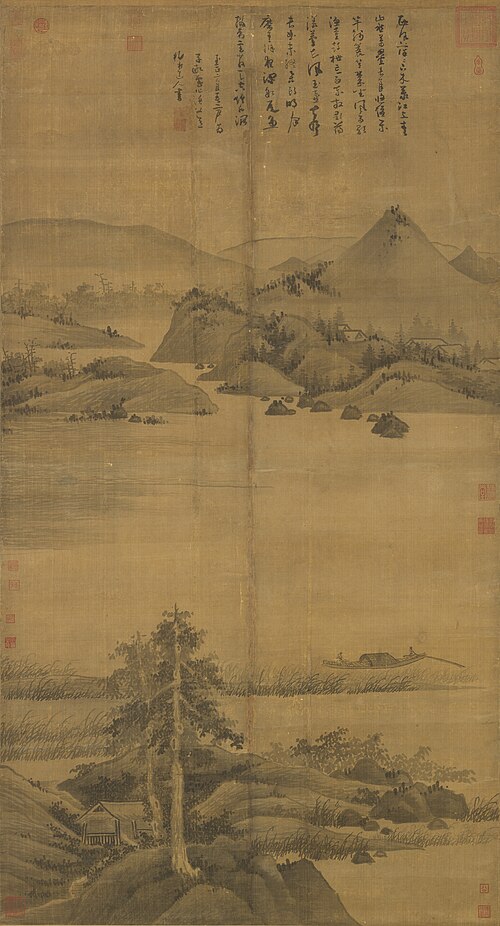
Wu Zhen, Fisherman dated 1342, ink on silk,
National Palace Museum, Taipei.
—public domain, via Wikimedia Commons
Empty Boats parable
“If a man is crossing a river in a boat, and another empty vessel comes into collision with it, even though he may be a man of choleric temper, he will not be angry with it. If there be a person, however, in that boat, he will bawl out to him to haul out of the way. If his shout be not heard, he will repeat it; and if the other do not then hear, he will call out a third time, following up the shout with abusive terms. Formerly, he was not angry, but now he is; formerly (he thought) the boat was empty, but now there is a person in it. If a man can empty himself of himself, during his time in the world, who can harm him?”
—Chuang Tzu
The story appears in Chapter 20, The Mountain Tree, of the Chuang Tzu*. It is not a free-standing parable. It is the closing image of a speech by a man called Yiliao of Shinan (市南宜僚) to the Marquis of Lu, who has just complained that he performs every rite and still cannot escape trouble.
*From Chuang Tzu, with contributions by Yutang Lin, Martin Palmer, James Legge, Burton Watson, Sam Hamill, J. P. Seaton, and Chad Hansen.

